使用蒙特卡洛模拟对欧式与二元期权定价

1. 引言

本文在风险中性框架下,使用蒙特卡洛模拟研究欧式看涨期权与二元看涨期权的定价问题。根据资产定价基本定理,期权价值 $V(S,t)$ 等于风险中性测度 $\mathbb{Q}$ 下贴现支付的期望:

$$V(S, t) = e^{-r(T-t)} \mathbb{E}^\mathbb{Q} [\text{Payoff}(S_T)]$$

假设标的资产价格服从几何布朗运动(GBM),其随机微分方程(SDE)为: $$dS_t = r S_t dt + \sigma S_t dW_t$$ 其中,$r$ 为无风险利率,$\sigma$ 为波动率,$dW_t$ 为维纳过程增量。

为模拟资产路径,本文采用三种数值方法:

  1. Euler-Maruyama 方法:一阶离散近似。 $$S_{t+\Delta t} = S_t + r S_t \Delta t + \sigma S_t \sqrt{\Delta t} Z$$
  2. Milstein 方法:包含 Itô 展开修正的高阶近似。 $$S_{t+\Delta t} = S_t + r S_t \Delta t + \sigma S_t \sqrt{\Delta t} Z + \frac{1}{2}\sigma^2 S_t \Delta t (Z^2 - 1)$$
  3. GBM 闭式解:该 SDE 的精确终值解。 $$S_T = S_0 \exp\left((r - \frac{1}{2}\sigma^2)T + \sigma \sqrt{T} Z\right)$$

此外,我们考察了 对偶变量法(Antithetic Variates)控制变量法(Control Variates) 两种方差缩减技术。

 1
 2
 3
 4
 5
 6
 7
 8
 9
10
11
12
13
14
15
16
17
18
19
20
21
22
23
24
25
26
27
28
29
30
31
32
33
34
35
36
37
38
39
40
41
42
43
44
45
46
47
48
49
50
51
52
53
54
55
56
57
58
59
60
61
62
63
64
65
import numpy as np
import pandas as pd
import matplotlib.pyplot as plt
from scipy.stats import norm
from IPython.display import display

# Environment & Base Parameters
plt.style.use('ggplot')
np.random.seed(42) 

S0_base, E_base, T_base, sigma_base, r_base = 100.0, 100.0, 1.0, 0.20, 0.05
N_paths, M_steps = 100000, 252 

# Black-Scholes Benchmark & Payoffs
def bs_euro_call(S0, E, T, r, sigma):
    d1 = (np.log(S0 / E) + (r + 0.5 * sigma**2) * T) / (sigma * np.sqrt(T))
    d2 = d1 - sigma * np.sqrt(T)
    return S0 * norm.cdf(d1) - E * np.exp(-r * T) * norm.cdf(d2)

def bs_bina_call(S0, E, T, r, sigma):
    d1 = (np.log(S0 / E) + (r + 0.5 * sigma**2) * T) / (sigma * np.sqrt(T))
    d2 = d1 - sigma * np.sqrt(T)
    return np.exp(-r * T) * norm.cdf(d2)

def payoff_euro(ST, E): return np.maximum(ST - E, 0)
def payoff_bina(ST, E): return np.where(ST > E, 1.0, 0.0)

# Monte Carlo Engines
def simulate_paths(S0, T, r, sigma, N, M, method='closed'):
    dt = T / M; ST = np.full(N, S0)
    if method == 'closed':
        ST = S0 * np.exp((r - 0.5 * sigma**2) * T + sigma * np.sqrt(T) * np.random.standard_normal(N))
    elif method == 'euler':
        for _ in range(M): ST += r * ST * dt + sigma * ST * np.sqrt(dt) * np.random.standard_normal(N)
    elif method == 'milstein':
        for _ in range(M):
            Z = np.random.standard_normal(N)
            ST += r * ST * dt + sigma * ST * np.sqrt(dt) * Z + 0.5 * sigma**2 * ST * dt * (Z**2 - 1)
    return ST

def simulate_history_path(S0, T, r, sigma, N, M):
    dt = T / M; paths = np.zeros((M + 1, N)); paths[0] = S0
    for t in range(1, M + 1):
        paths[t] = paths[t-1] + r * paths[t-1] * dt + sigma * paths[t-1] * np.sqrt(dt) * np.random.standard_normal(N)
    return paths

# Pricing & Variance Reduction
def price_mc(ST, payoff_func, E, r, T):
    discounted_payoffs = np.exp(-r * T) * payoff_func(ST, E)
    return np.mean(discounted_payoffs), np.std(discounted_payoffs, ddof=1) / np.sqrt(len(ST))

def price_anti(S0, E, T, r, sigma, N, payoff_func):
    N_half = N // 2; Z = np.random.standard_normal(N_half)
    ST1 = S0 * np.exp((r - 0.5 * sigma**2) * T + sigma * np.sqrt(T) * Z)
    ST2 = S0 * np.exp((r - 0.5 * sigma**2) * T + sigma * np.sqrt(T) * (-Z))
    discounted = np.exp(-r * T) * 0.5 * (payoff_func(ST1, E) + payoff_func(ST2, E))
    return np.mean(discounted), np.std(discounted, ddof=1) / np.sqrt(N_half)

def price_cont_variate(S0, E, T, r, sigma, N, payoff_func):
    Z = np.random.standard_normal(N)
    ST = S0 * np.exp((r - 0.5 * sigma**2) * T + sigma * np.sqrt(T) * Z)
    Y = payoff_func(ST, E) * np.exp(-r * T); X = ST; EX = S0 * np.exp(r * T) 
    theta = np.cov(X, Y)[0, 1] / np.cov(X, Y)[0, 0]
    Y_cv = Y - theta * (X - EX)
    return np.mean(Y_cv), np.std(Y_cv, ddof=1) / np.sqrt(N)

2. 基础模型可视化:资产路径

 1
 2
 3
 4
 5
 6
 7
 8
 9
10
11
12
13

print("simulating asset paths!")
M_plot, N_plot = 252, 100
paths = simulate_history_path(S0_base, T_base, r_base, sigma_base, N_plot, M_plot)
time_grid = np.linspace(0, T_base, M_plot + 1)

plt.figure(figsize=(10, 5))
plt.plot(time_grid, paths, lw=1, alpha=0.6)
plt.axhline(E_base, color='black', linestyle='--', linewidth=2, label='Strike Price (E=100)')
plt.title(f'Monte Carlo Simulation: {N_plot} Simulated Asset Paths (GBM)', fontsize=14)
plt.xlabel('Time to Maturity (Years)'); plt.ylabel('Asset Price (S_t)')
plt.legend(); plt.tight_layout()
plt.show()

图 1 - 基础模型可视化

3. 结果:价格与标准误对比

 1
 2
 3
 4
 5
 6
 7
 8
 9
10
11
12
13
14
15
16
17
18
19
20
21
22
23
24
25
26
27
28
29
30
31
32
33
34
35
36
37
38
39
40
41
42
43
44
def run_experiment(option_type):
    payoff_f = payoff_euro if option_type == 'European' else payoff_bina
    bs_price = bs_euro_call(S0_base, E_base, T_base, r_base, sigma_base) if option_type == 'European' else bs_bina_call(S0_base, E_base, T_base, r_base, sigma_base)
    results = []
    
    # Baseline
    ST_base = simulate_paths(S0_base, T_base, r_base, sigma_base, N_paths, M_steps, 'closed')
    p_base, se_base = price_mc(ST_base, payoff_f, E_base, r_base, T_base)
    var_base = se_base**2
    
    # run each method and collect results
    for method in ['euler', 'milstein', 'closed']:
        ST = simulate_paths(S0_base, T_base, r_base, sigma_base, N_paths, M_steps, method)
        p, se = price_mc(ST, payoff_f, E_base, r_base, T_base)
        # for standard method,VRR should be N/A or 1.0
        results.append((method.capitalize(), p, se, abs(p - bs_price), 1.0))
        
    # Caculate VRR
    p_anti, se_anti = price_anti(S0_base, E_base, T_base, r_base, sigma_base, N_paths, payoff_f)
    vrr_anti = var_base / (se_anti**2) 
    results.append(('Antithetic', p_anti, se_anti, abs(p_anti - bs_price), vrr_anti))
    
    p_cv, se_cv = price_cont_variate(S0_base, E_base, T_base, r_base, sigma_base, N_paths, payoff_f)
    vrr_cv = var_base / (se_cv**2)
    results.append(('Control Variate', p_cv, se_cv, abs(p_cv - bs_price), vrr_cv))
    
    # add VRR
    df = pd.DataFrame(results, columns=['Method', 'Price', 'Standard Error', 'Abs Error vs BS', 'VR Ratio (Multiplier)'])
    return df.set_index('Method'), bs_price

# PRINT RESULTS
df_euro, bs_euro = run_experiment('European')
df_binary, bs_binary = run_experiment('Binary')
print(f"hyy:European Call Options (BS Exact Price: {bs_euro:.4f})"); display(df_euro)
print(f"\n hyy: Binary Call Options (BS Exact Price: {bs_binary:.4f})"); display(df_binary)

# plot the diagram
fig, ax = plt.subplots(figsize=(10, 5))
x = np.arange(len(df_euro.index)); width = 0.35
rects1 = ax.bar(x - width/2, df_euro['Standard Error'], width, label='European Call', color='steelblue')
rects2 = ax.bar(x + width/2, df_binary['Standard Error'], width, label='Binary Call', color='darkorange')
ax.set_ylabel('Standard Error (SE)'); ax.set_title('Standard Error Comparison across Variance Reduction Methods')
ax.set_xticks(x); ax.set_xticklabels(df_euro.index, rotation=15); ax.legend()
plt.tight_layout(); plt.show()

图 2 - 欧式与二元期权定价结果

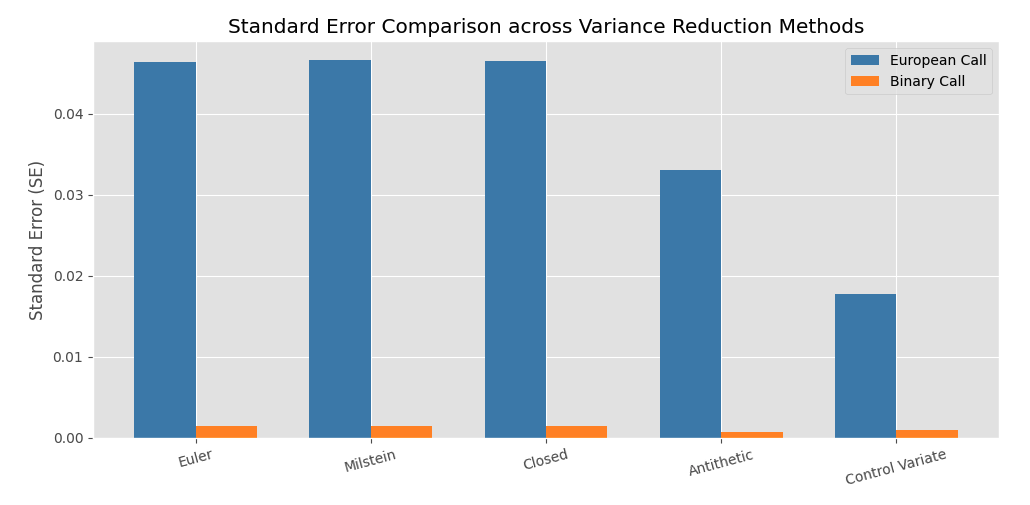
图 3 - 标准误对比

观察:方差缩减(VR)带来的效率提升

这一部分可以从四点来理解:

第一,关于离散化误差与采样效率:从 Euler 切换到 Milstein 主要改善的是离散化偏差,但对 标准误(SE) 的影响很小。结果显示 Euler、Milstein 与闭式解三者的 SE 基本接近。这说明 SE 主要由样本量($N$)与支付函数方差决定,而不是离散化格式本身。

第二,对偶变量法的表现:对偶变量法带来明显提升,欧式看涨的 VR 比率约 1.99x,二元看涨更高(约 4.64x)。通过构造负相关路径,它能抵消部分采样噪声,在相同计算预算下收窄置信区间。

第三,控制变量法(CV)的主导优势:在欧式看涨上,控制变量法效果最强,VR 比率约 6.88x。其核心是利用已知解析性质且与目标变量高度相关的控制变量(如标的终值)来显著降低剩余方差。

第四,支付函数敏感性:在本次实验中,对二元看涨而言,对偶变量法反而优于控制变量法(4.64 vs 2.45)。这表明 VR 技术效果对支付函数的不连续性凸性高度敏感。

4. 收敛性与稳定性分析

 1
 2
 3
 4
 5
 6
 7
 8
 9
10
11
12
13
14
15
16
17
18
19
20
21
22
23
24
25
26
27
28
29
30
31
32
33
34
35
36
37
38
39
40
41
fig, (ax1, ax2) = plt.subplots(1, 2, figsize=(14, 5))

# Log-Log Convergence Analysis
Ns_list = [500, 1000, 2000, 5000, 10000, 20000]
repeats = 30  

anchor_error = 0

for method in ['euler', 'milstein', 'closed']:
    errs_mean = []
    for n in Ns_list:
        err_n = []
        for _ in range(repeats):
            ST = simulate_paths(S0_base, T_base, r_base, sigma_base, n, 252, method)
            p, _ = price_mc(ST, payoff_euro, E_base, r_base, T_base)
            err_n.append(abs(p - bs_euro))
        errs_mean.append(np.mean(err_n)) 
        
    if method == 'closed':
        anchor_error = errs_mean[0]
        
    ax1.plot(Ns_list, errs_mean, marker='o', label=method.capitalize())

# in order to make the reference line more visible, multiply the anchor_error by 2
ref_line = (anchor_error * 2) * (np.array(Ns_list) / Ns_list[0])**(-0.5)
ax1.plot(Ns_list, ref_line, 'k--', label='Theoretical $O(N^{-1/2})$')

ax1.set(xscale='log', yscale='log', title='Log-Log Convergence Analysis', xlabel='Number of Paths (N)', ylabel='Mean Absolute Error')
ax1.legend()

# Seed Stability
seed_prices = [price_mc(simulate_paths(S0_base, T_base, r_base, sigma_base, 10000, 1, 'closed'), payoff_euro, E_base, r_base, T_base)[0] for s in range(100)]
ax2.hist(seed_prices, bins=15, color='lightblue', edgecolor='black', alpha=0.8)
ax2.axvline(bs_euro, color='red', linestyle='--', linewidth=2, label='BS Exact Price')
ax2.axvline(np.mean(seed_prices), color='green', linestyle='-', linewidth=2, label='Monte Carlo Mean')
ax2.set(title='Monte Carlo Price Distribution (100 Seeds)', xlabel='Estimated Price', ylabel='Frequency')
ax2.legend()

plt.tight_layout()
plt.show()
np.random.seed(42) # reset back the seed

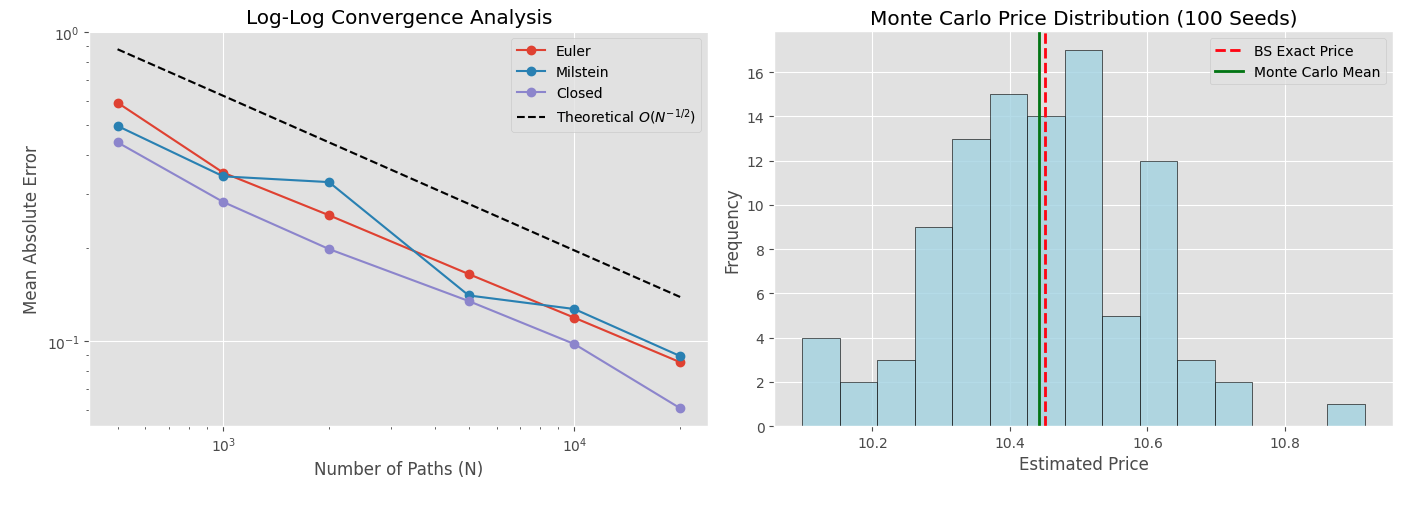
图 4 - 收敛性与稳定性分析

观察

第一张图说明了以下几点:

  • 关于收敛速度与离散化偏差
  1. 理论收敛阶($O(N^{-1/2})$):log-log 图显示三种数值方法的误差下降轨迹都与理论参考线基本平行,经验上验证了蒙特卡洛估计方差符合中心极限定理。
  2. 离散化偏差:曲线之间的垂直间距揭示了时间离散误差。Euler 方法(一阶)绝对误差最大;Milstein 方法通过二阶 Itô 修正显著降低偏差;闭式解(精确 GBM)不存在时间离散偏差,剩余误差主要来自统计采样方差。
  • 强收敛与弱收敛的权衡
  1. 路径精度(强收敛)角度:Milstein 通过考虑波动率拖曳项($1/2 \sigma^2 \dots$),使单条模拟路径更贴近“真实路径”,这对路径依赖产品(如美式、障碍期权)很关键。
  2. 分布统计(弱收敛)角度:对于整体统计量(如此处均值绝对误差),Milstein 相对 Euler 的优势可能有限,因为二者弱收敛阶同为 $O(\Delta t)$。在只看终值期望时,Milstein 的非线性修正有时会让结果在 Euler 附近波动。
  3. 实务选择:结果表明,若目标是简单欧式类期望定价,与其提升离散化复杂度,不如在标准 Euler 上结合方差缩减,往往更具计算效率。

第二张图可得:

  1. 100 个随机种子下的蒙特卡洛估计分布紧密围绕 Black-Scholes 精确值,样本均值(绿线)与解析基准(红线)高度一致,说明估计器无偏。
  2. 对称钟形直方图从可视化上验证了中心极限定理,也说明了蒙特卡洛的固有噪声,因此方差缩减对于提升效率非常关键。

5. 敏感性分析(参数变化)

 1
 2
 3
 4
 5
 6
 7
 8
 9
10
11
12
13
14
15
16
17
18
19
20
21
22
23
24
25
26
27
import matplotlib.pyplot as plt
import numpy as np

fig, (ax1, ax2) = plt.subplots(1, 2, figsize=(14, 5))

#  Volatility Effect
volatilities = np.linspace(0.05, 0.50, 10)
euro_prices_vol = [price_mc(simulate_paths(S0_base, T_base, r_base, v, N_paths, 1, 'closed'), payoff_euro, E_base, r_base, T_base)[0] for v in volatilities]
binary_prices_vol = [price_mc(simulate_paths(S0_base, T_base, r_base, v, N_paths, 1, 'closed'), payoff_bina, E_base, r_base, T_base)[0] for v in volatilities]

ax1.plot(volatilities, euro_prices_vol, label='European Call', marker='o')
ax1.plot(volatilities, binary_prices_vol, label='Binary Call', marker='s')
# fix bug: fix the label for volatility with r and \sigma
ax1.set(title='Option Price vs Volatility', xlabel=r'Volatility ($\sigma$)', ylabel='Price')
ax1.legend()

# Strike Effect 
strikes = np.linspace(80, 120, 10)
binary_se_strike = [price_mc(simulate_paths(S0_base, T_base, r_base, sigma_base, N_paths, 1, 'closed'), payoff_bina, k, r_base, T_base)[1] for k in strikes]

ax2.plot(strikes, binary_se_strike, color='red', marker='^')
ax2.axvline(S0_base, color='black', linestyle='--', label='At-The-Money (S0=100)')
ax2.set(title='Binary Option SE vs Strike (Discontinuity Effect)', xlabel='Strike Price (E)', ylabel='Standard Error (SE)')
ax2.legend()

plt.tight_layout()
plt.show()

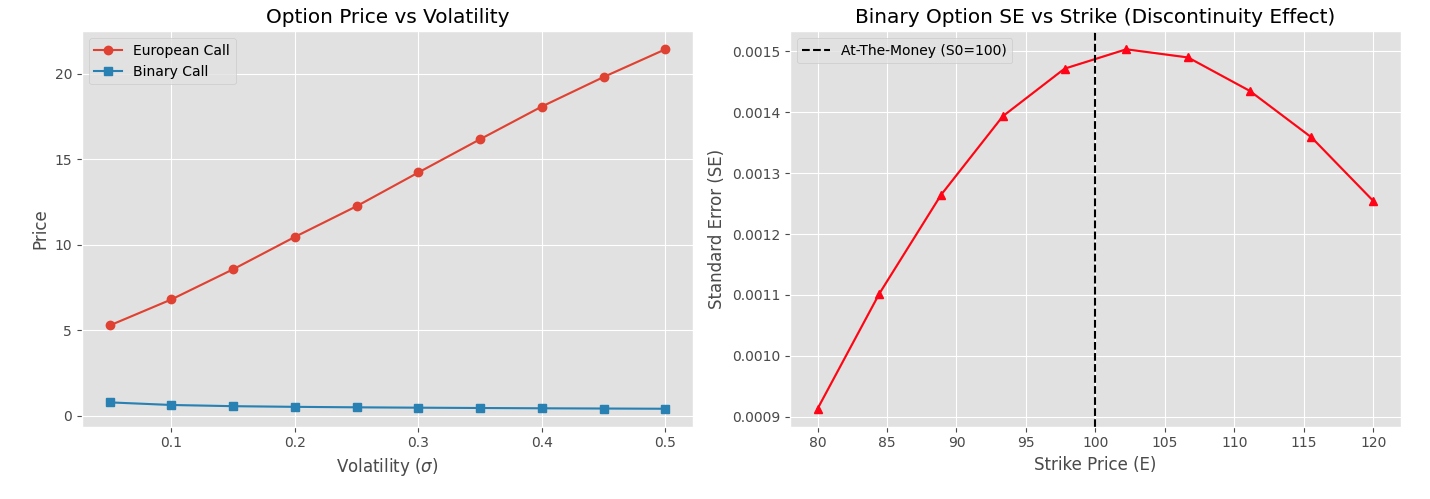
图 5 - 敏感性分析

关于波动率敏感性图(Vega 分化)

  • 敏感性分析显示出一个关键分化:随着隐含波动率上升,欧式看涨价格单调上升(正 Vega),而平值(ATM)二元看涨价格在本实验设置下下降(负向表现)。
  • 对欧式期权而言,由于支付函数 $\max(S_T - E, 0)$ 的凸性,高不确定性带来的右尾扩张总体有利:上行收益不封顶、下行损失下限为 0。相反,ATM 二元期权支付上限固定为 1。波动率升高会把更多路径推向极端值,但上行额外空间被封顶,向下偏离却会完整损失支付,因此风险中性下实值概率被稀释,期望价值下降。

关于二元期权支付不连续性

  • 二元期权的标准误(SE)在平值点($E = S_0 = 100$)附近显著抬升。
  • 原因是其支付函数高度不连续(Heaviside 阶跃函数)。当模拟终值 $S_T$ 非常接近执行价 $E$ 时,极小随机扰动就会导致支付在 0 与 1 之间翻转,从而显著放大统计方差,使标准蒙特卡洛在 ATM 二元期权上效率明显低于连续支付的欧式期权。

6. 观察与遇到的问题

二元期权与欧式期权的差异:

  • 观察: 二元期权的标准误(SE)行为与欧式期权明显不同。二元期权在平值(ATM,$E=100$)附近方差会出现尖峰。
  • 原因: 这来自二元支付函数的强不连续性(从 0 到 1 的阶跃)。执行价附近路径的微小变动会引起支付结果的大幅跳变。

方差缩减效率:

  • 控制变量法: 对欧式期权非常有效,方差缩减比(VRR)约为 7.0x(SE 约降低到原来的 $1/\sqrt{7}$)。其高效率来自 ATM 欧式支付 $\max(S_T - E, 0)$ 与连续控制变量 $S_T$ 之间较强的正相关($\rho \approx 0.92$)。
  • 遇到的问题: 在二元期权上该效率显著下降。由于二元支付上限固定为 1,其与无界的 $S_T$ 线性相关性较弱,该控制变量对不连续数字支付的效果明显变差。

收敛与离散化:

  • Log-Log 分析显示经验误差符合理论 $O(N^{-1/2})$ 收敛率。
  • Euler 的时间离散偏差最大,Milstein 通过 Itô 修正提高了精度。

7. 结论

  • 对于路径依赖型复杂衍生品,Euler 与 Milstein 仍是必要方法;但对路径无关的欧式与二元期权,GBM 闭式终值法由于完全消除了时间步进偏差,通常更优。

  • 就方差缩减而言,基于标的终值 $S_T$ 的控制变量法在连续支付(欧式看涨)上效果非常强;但在不连续支付(二元看涨)上,线性关系减弱导致效率明显下降。

  • 总结:数值方法不能“一套通吃”,应根据支付函数的数学结构(连续/不连续)进行针对性选择。

8. 参考文献

  1. Hull, J. C. (2018). Options, Futures, and Other Derivatives. Pearson.
  2. Glasserman, P. (2003). Monte Carlo Methods in Financial Engineering. Springer.
  3. Higham, D. J. (2001). “An Algorithmic Introduction to Numerical Simulation of Stochastic Differential Equations”. SIAM Review.